Analyzing global market dynamics, extreme environmental challenges, and the engineering shift toward certified outdoor tool chests.
The global commercial tool storage market is undergoing a structural paradigm shift. According to recent industrial hardware trade indices, demand for TUV-certified outdoor tool chests and heavy-duty weatherized mobile cabinets has surged by 14.8% year-over-year. As industrial projects shift toward off-grid renewable infrastructure, offshore wind maintenance, mining sites, aerospace support, and mobile service fleets, standard indoor garage toolboxes are no longer sufficient. Enterprise procurement teams require storage solutions capable of surviving salt-spray oxidation, extreme thermal fluctuations (-40°C to +80°C), heavy vibration, and high-impact mechanical stress.
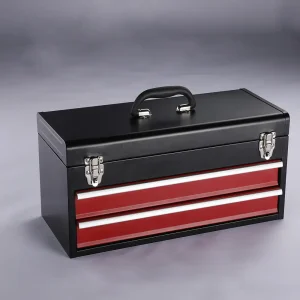
Outdoor tool chests engineered for field technicians utilize dual-lip EPDM perimeter gaskets, continuous stainless steel piano hinges, and UV-stabilized powder coatings to prevent moisture penetration and corrosion in humid or coastal environments.
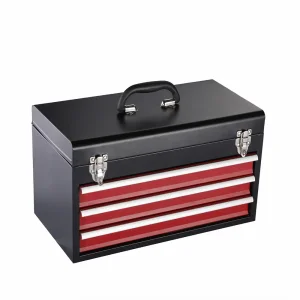
TUV-certified designs feature integrated anti-tilt interlock systems, preventing multi-drawer opening under heavy load conditions, thereby eliminating tipping hazards on uneven outdoor terrain or mobile work trucks.
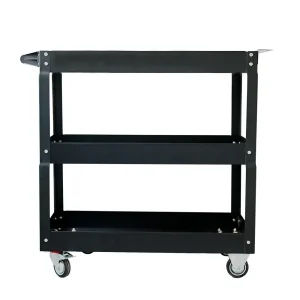
Commercial buyers prioritize high-security tubular locking systems, central padlocking bars, reinforced forklift pockets, and heavy-duty polyurethane casters engineered for rugged field movement.
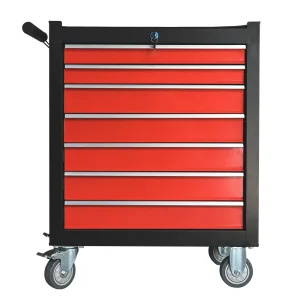
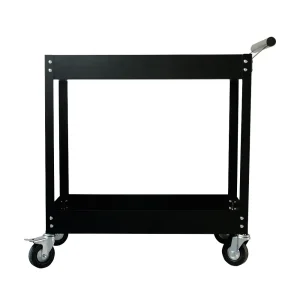
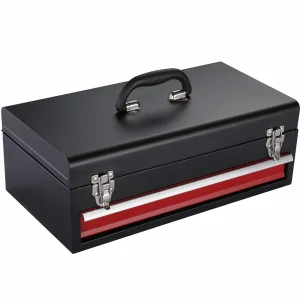
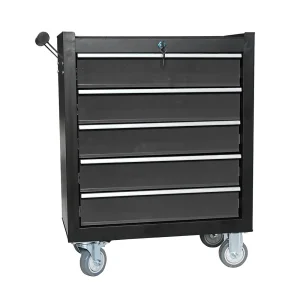
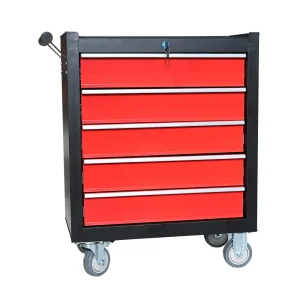
Featured high-performance storage solutions designed for industrial suppliers, fleet managers, and international distributors.
Understanding the rigorous engineering compliance, mechanical testing, and safety audits required by international accreditation bodies.
TUV accreditation requires rigorous mechanical stability audits. Outdoor tool chests undergo overload testing, where drawers are loaded to 150% rated capacity and cycled 50,000 times on industrial ball-bearing slides to verify structural deflection limits under extreme operational stress.
To qualify for TUV outdoor durability marks, metal toolboxes are subjected to continuous neutral salt spray (NSS) chamber testing for 720 to 1,000 hours. Top-tier manufacturers utilize electro-galvanized SPCC steel substrate coated with thermosetting epoxy-polyester powder at a thickness of 80–120 microns.
Outdoor tool chest enclosures must seal completely against windblown dust, rain, and pressure washing. TUV testing verifies that integrated perimeter foam gaskets maintain memory retention and sealing elasticity after exposure to severe thermal cycling (-30°C to +70°C).
When reviewing TUV test certificates, global sourcing directors must differentiate between Static Load Capacity (maximum total weight supported while stationary on level concrete) and Dynamic Load Capacity (maximum weight supported while rolling across uneven terrain or undergoing vehicle transit vibrations). TUV certification mandates that rolling outdoor cabinets maintain a 4:1 safety factor for structural welds and caster stem mountings during dynamic movement testing.
How modern Chinese tool chest factories combine advanced automation, raw material scalability, and strict quality assurance to deliver global OEM/ODM solutions.
State-of-the-art Chinese manufacturing facilities deploy 10,000W fiber laser cutting centers and automated CNC turret punch presses, maintaining strict dimensional tolerances within ±0.05mm across mass-produced tool chest components.
By replacing manual spot welding with 6-axis Fanuc and ABB robotic welding cells, Chinese factories ensure 100% seam penetration and consistent weld strength, eliminating structural weak points vulnerable to transport fatigue.
From in-house mold tooling to continuous automated electrostatic powder coating lines and specialized export packaging, Chinese tool chest hubs offer global buyers an unmatchable balance of low FOB unit costs and high build quality.
A detailed technical comparison of tool chest raw materials, mechanical strengths, and surface finishes used by leading TUV-certified manufacturers.
| Material / Parameter | SPCC Cold-Rolled Steel | 5052-H32 Aluminum Alloy | Reinforced Polypropylene (PP) |
|---|---|---|---|
| Tensile Strength (MPa) | 270 – 410 MPa | 210 – 260 MPa | 35 – 45 MPa |
| Corrosion Resistance Rating | High (When Powder Coated) | Exceptional (Self-Passivating) | Immune to Rust / Chemical Inert |
| Impact Strength (-20°C) | Very High (No Brittle Fracture) | High | Moderate (Requires Impact Modifiers) |
| Drawer Slide Capacity | Heavy Duty (45kg – 120kg/drawer) | Medium Duty (30kg – 60kg/drawer) | Light to Medium Duty (15kg – 35kg) |
| TUV Fire Safety Class | Class A1 (Non-Combustible) | Class A1 (Non-Combustible) | Class HB / V-2 Rated Plastic |
| Primary Target Application | Industrial Workstations, Fleet Trucks | Marine, Lightweight Mobile Service | Handheld Portable Field Tool Cases |
Deploying TUV-rated outdoor tool chests across demanding global sectors and hostile work environments.
Maintenance technicians working on offshore wind turbines and desert solar farms require tool chests with IP65 weather seals, anti-corrosive hardware, and tie-down points to endure salt mist and blowing sand.
Utility service trucks demand low-profile, heavy-duty drawer toolboxes with positive locking latches that remain securely shut during high-speed highway travel and off-road vibrations.
Open-pit mining sites utilize multi-drawer rolling tool cabinets fitted with extra-large 6-inch shock-absorbing polyurethane casters, central cylinder locking systems, and heavy-gauge steel side handles for master mechanic tools.
Key technical parameters to evaluate when auditing tool chest suppliers and negotiating OEM/ODM contracts.
Verify that the manufacturer uses specified nominal steel gauges (e.g., 1.0mm - 1.5mm body thickness, 0.8mm - 1.0mm drawer thickness) rather than thin unrated sheet steel post-powder coat measuring.
Ensure drawer slides utilize heat-treated carbon steel ball bearings with soft-close or auto-return mechanisms rated for at least 45kg dynamic load per drawer pair.
Request ISO 2409 cross-cut tape adhesion test results (Class 0 required) and verify electrostatically applied powder coat thickness via magnetic gauge (min. 80μm).
Insist on tubular barrel locks with master key options or digital combination locks to prevent unauthorized tool access across large job sites or commercial fleets.
Confirm compliance with ISTA 3A drop-test standards, heavy-corner honeycomb edge protection, and double-wall corrugated cartons on export pallets to eliminate transit damage.
Directly cross-check TUV certificate numbers on the official TUV Rheinland Certipedia database to verify genuine accreditation and factory audit compliance.
Explore full product specifications, custom OEM options, and global export configurations.
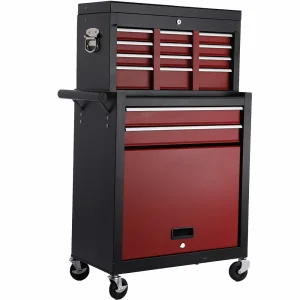
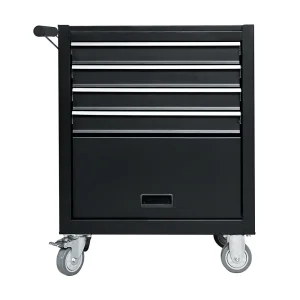
In-depth engineering and commercial answers for OEM buyers, distributors, and supply chain directors.
To earn TUV Rheinland or TUV SÜD approval for outdoor applications, a metal tool chest must undergo a rigorous battery of tests under standards like DIN EN 14073 (Office and Industrial Furniture Structural Requirements) and ISO 9227 (Corrosion Tests in Artificial Atmospheres). Testing includes a 50,000-cycle drawer fatigue endurance test under full dynamic payload, a drop-impact test at extreme sub-zero temperatures (-25°C), an anti-tilt stability evaluation (ensuring the cabinet does not tip when loaded drawers are fully extended), and a 720-to-1,000-hour salt spray corrosion test.
Chinese factories achieve cost efficiency through scale, supply chain integration, and Industry 4.0 automation. Industrial manufacturing hubs in Zhejiang integrate cold-rolled steel coil processing, automated laser cutting, robotic welding, and inline powder coating under one roof. This minimizes internal logistics overhead, reduces material scrap rates below 2%, and allows manufacturers to offer enterprise buyers certified quality at direct factory pricing.
An IP65 rating signifies complete protection against dust ingress and resistance to low-pressure water jets from any direction—ideal for rain-exposed service trucks and construction sites. An IP67 rating indicates complete dust tightness plus protection against temporary water immersion up to 1 meter depth for 30 minutes, which is required for extreme off-road, marine deck, or field military operations.
Anti-tilt mechanisms permit only one drawer to open at a time. In heavy-duty cabinets where each drawer holds 45kg to 120kg of steel tools, opening multiple drawers simultaneously shifts the center of gravity forward, causing the unit to tip over violently. TUV safety standards mandate single-drawer interlock systems to protect workers from crush injuries in active industrial environments.
A dual-layer coating system delivers optimal protection: an initial zinc-rich epoxy primer (40-50μm) followed by a super-durable architectural polyester topcoat (60-80μm). This combination provides UV resistance against chalking and cracking, while maintaining Class 0 adhesion (ISO 2409) and resisting salt fog under ASTM B117 standards.
Yes. Modern OEM factories provide complete customization options, including custom RAL powder coating color matching, screen-printed or laser-engraved corporate logos, tailored drawer height ratios, custom EVA foam tool inserts, and specialized mounting brackets for service vehicles.
Heavy-duty polyurethane (PU) tread bonded to cast-iron or aluminum wheel hubs offers the best balance. PU casters resist oil, grease, and chemical spills without flat-spotting, while providing shock absorption across outdoor gravel, debris, and concrete expansion joints. Dual-pedal total-lock brakes ensure zero swivel or roll when parked.
Buyers can engage third-party inspection agencies (such as SGS, TÜV Rheinland, or Bureau Veritas) to perform During Production (DUP) or Pre-Shipment Inspections (PSI). Auditors check structural dimensions, coating thickness, drawer cycle smoothness, packaging drop resistance, and lock functionality according to AQL 2.5 acceptance sampling standards.