Explore our CE-certified engineering lineup designed for heavy-duty commercial deployment, warehouse automation integration, and ergonomic mobility.
An engineering and supply chain analysis of non-powered material handling equipment across European, North American, and Asia-Pacific industrial sectors.
In the modern global logistics ecosystem, the humble two-wheel hand dolly (frequently referenced as a hand truck, sack truck, or industrial upright trolley) serves as a critical link in last-mile delivery, intra-factory material transfer, and commercial warehousing. As automation transforms macro-logistics centers, manual handling equipment faces stringent regulatory scrutiny regarding operational safety, structural integrity, and ergonomic compliance. Sourcing managers and procurement executives seeking CE Certification Two Wheel Hand Dolly Suppliers & Companies must navigate complex international engineering directives to ensure legal compliance, worker safety, and long-term total cost of ownership (TCO) optimization.
Core Procurement Insight: CE marking on a two-wheel hand dolly is not merely a trading stamp; it represents verified adherence to the European Machinery Directive 2006/42/EC and essential health and safety requirements (EHSR). Substandard suppliers often issue self-declarations without comprehensive Technical Construction Files (TCF) or third-party laboratory dynamic fatigue testing. Technical buyers must audit ISO 17025 certified lab reports to prevent import seizures and liability claims.
Global demand drivers for high-specification hand dollies have shifted from low-cost disposable steel tubing designs toward lightweight, high-yield aluminum alloys, convertible multi-position chassis, and integrated stair-climbing kinematics. Key sectors driving wholesale procurement include:
Demanding high-frequency usage, puncture-proof micro-cellular polyurethane tires, high-impact toe plates, and ergonomic loop handles designed to minimize musculoskeletal strain during repetitive loading cycles.
Requiring extreme payload capabilities (300kg to 500kg+), heavy-gauge structural steel frames, chemical-resistant powder coatings, and specialized wheel bearings engineered for oily shop floors.
Emphasizing quiet-rolling thermoplastic rubber (TPR) treads, non-marking bumpers, modular accessories (stair glides, extended nose plates), and compact folding frame geometry for van storage.
Deconstructing the structural integrity, finite element analysis (FEA), and biometric design parameters of modern two-wheel hand dollies.
The structural efficacy of an industrial hand dolly hinges on the balance between deadweight and payload capacity. Premier manufacturers utilize advanced Finite Element Analysis (FEA) to eliminate stress concentration points at critical frame welds and axle bracket assemblies. Below is an engineering comparison of primary structural materials utilized by certified global suppliers:
| Material Specification | Yield Strength (MPa) | Strength-to-Weight Ratio | Corrosion Resistance | Primary Industrial Application |
|---|---|---|---|---|
| 6061-T6 Extruded Aluminum Alloy | 276 MPa | Exceptionally High | Superior (Self-passivating oxide) | Beverage distribution, parcel delivery, mobile service trucks |
| Cold-Rolled Structural Steel (Q235/ST37) | 235 MPa | Moderate | Requires Electrostatic Powder Coating | Heavy plant maintenance, construction sites, high-tonnage warehouses |
| Chromoly Alloy Tubing (4130) | 460 MPa | Ultra-High | High (When properly plated/painted) | Specialized aerospace ground handling, high-stress custom equipment |
| High-Density Reinforced Polymer Matrix | 120 MPa | High (Vibration Damping) | Immune to chemical corrosion | Cleanroom environments, pharmaceutical plants, chemical storage |
Rolling resistance directly dictates operator fatigue and physical exertion limits under ISO 11228-2 manual material handling standards. Professional CE-certified hand trucks utilize dual precision-sealed ABEC-5 or ABEC-7 deep groove ball bearings housed within cast aluminum or high-impact polypropylene hubs.
The mechanical advantage ratio ($MA$) of a two-wheel dolly is governed by the distance from the wheel axle pivot point to the handle grip relative to the distance from the axle to the load center of gravity ($CoG$). Advanced designs incorporate curved back-bracing for cylindrical containers (kegs, drums) and telescoping ergonomic dual-handles that allow operators to maintain a neutral spinal position during tilt-back and transit phases.
Deep dive into EU directives, risk assessment protocols, chemical safety, and factory audit criteria for international trade compliance.
While manually operated hand trucks without mechanical power assistance fall into specific scope categories, CE alignment mandates compliance with Essential Health and Safety Requirements (EHSR) regarding structural stability, load retention, sharp edge elimination, and pinch-point risk mitigation.
Harmonized European standards define static load proof testing (typically 1.5x rated nominal load held for 15 minutes without permanent deformation) and dynamic overload impact testing to verify weld joint fatigue strength.
Rubber hand grips, plastic hub moldings, and powder coating chemistry must undergo GS-mark PAH (Polycyclic Aromatic Hydrocarbons) testing and SVHC (Substances of Very High Concern) screening under EU Regulation (EC) No 1907/2006.
When importing CE-certified hand trucks into the European Single Market, B2B buyers must ensure the supplier provides a legally compliant TCF dossier containing:
Navigating supplier selection, factory audits, packaging optimization, and total cost of ownership (TCO) in international procurement.
Tier-1 CE certified hand truck manufacturers maintain vertically integrated facilities featuring automated fiber laser metal tube cutting, robotic MIG/TIG welding cells, electro-static powder coating lines, and computerized wheel durability testing rigs. Sourcing teams should prioritize factories holding ISO 9001:2015 Quality Management and BSCI (Business Social Compliance Initiative) audit certifications.
Freight costs significantly impact landed unit cost. Qualified OEM exporters offer Knock-Down (KD) or Semi-Knock-Down (SKD) packaging solutions where handles and toe-plates are modularized, allowing up to 2.5x more units per 40ft High Cube container compared to fully assembled (CBU) units. High-density corrugated packaging with drop-test approval (ISTA 1A) ensures damage-free transit.
OEM/ODM Customization Capabilities: Top-tier suppliers provide bespoke engineering services including custom toe plate dimensions (extruded vs cast aluminum), custom pantone powder coatings, company logo laser-etched onto structural frames, specialized stair-climber tri-wheel assemblies, and custom tire tread patterns designed for specialized industries.
Expert guidance addressing key compliance, engineering specifications, maintenance protocols, and international purchasing queries.
Valid CE compliance requires comprehensive testing aligned with European mechanical and ergonomic standards. Key tests include Static Proof Load Testing (holding 1.5 times nominal capacity without permanent structural bending), Dynamic Overload Dynamic Drop Testing (verifying frame integrity when moving over obstacle thresholds under load), Handle Deflection & Tensile Analysis, and REACH/PAH Chemical Analysis of rubber/plastic components in direct operator contact.
Aluminum hand dollies (typically constructed from high-yield 6061-T6 alloy) offer up to 45% weight reduction compared to steel, drastically reducing operator fatigue and increasing delivery route efficiency. Aluminum is naturally corrosion-resistant, resulting in longer service lives in wet or outdoor environments. Steel hand dollies, while heavier, offer higher impact resistance against extreme abuse at a lower initial purchase price point, making them ideal for stationary industrial plant use.
For general logistics and route delivery, Micro-Cellular Polyurethane (Flat-Free) tires represent the industry gold standard. They eliminate flat tire downtime, absorb terrain shock, and maintain a low rolling resistance. For indoor retail environments with polished floors, Thermoplastic Vulcanizate (TPV) or Non-Marking Solid Rubber tires are preferred to prevent floor scuffing and minimize roll noise.
Standard OEM production runs typically require an MOQ of 200 to 500 units per model, depending on the degree of custom tooling (e.g., custom toe plate extrusions or unique frame bends). Production lead times generally range from 25 to 35 days post-sample sign-off, with sample prototyping taking approximately 7 to 10 working days.
Ergonomic loop handles and dual-grip configurations allow operators to maintain a neutral wrist position regardless of load height or tilt angle. By keeping the center of gravity aligned closer to the wheel axle during movement, operator spinal compression forces are significantly reduced below the NIOSH lifting equation thresholds, directly lowering workers' compensation liability for logistics operators.
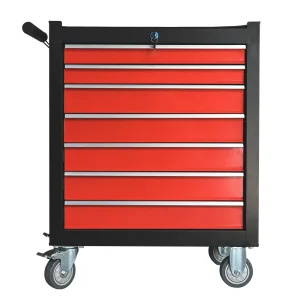
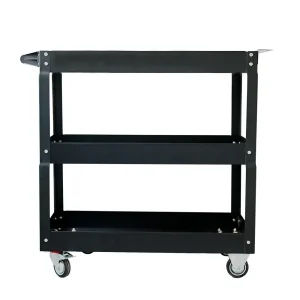
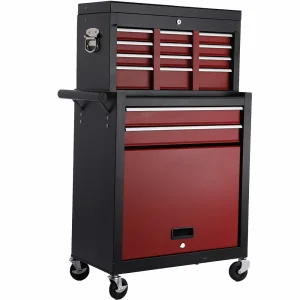
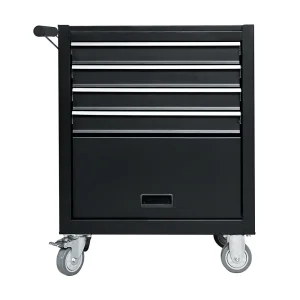
Discover our comprehensive range of high-load tool cabinets, interlocking mobile trolleys, and industrial storage systems.