How to Choose the Right Metal Enclosure Box?

Time:2026-10-22 Author:Charlotte
0%

Choosing the right Metal Enclosure Box is not simply a matter of selecting steel, stainless steel, or aluminum. The enclosure must match the equipment, environment, access needs, and expected service life. A box installed beside a dusty machine requires different protection than one mounted inside a clean control room. Heat, moisture, vibration, chemicals, and cable entry points can quietly weaken an otherwise sound design.

Rudolf Loh, founder of Rittal and a respected figure in industrial enclosure manufacturing, expressed the core principle clearly: “A good enclosure protects more than equipment; it protects continuity.” That idea remains practical today. Engineers should compare material thickness, corrosion resistance, cooling options, mounting space, door sealing, and grounding provisions. IEC 60529 IP ratings and relevant NEMA enclosure classifications can help, but ratings do not replace site evaluation. The rating is only part of the answer.

Small details matter.

A poorly positioned gland can admit water. A crowded interior can trap heat. A sharp unfinished edge can damage wiring during installation. These problems are easy to overlook when purchasing from a catalog. This guide examines how to choose a Metal Enclosure Box with greater confidence, from environmental exposure to customization and maintenance. It also recognizes an uncomfortable truth: the cheapest enclosure may become the most expensive choice after corrosion, overheating, or difficult servicing appears. No selection is perfect. However, careful questioning, documented requirements, and real installation experience can reduce avoidable mistakes.
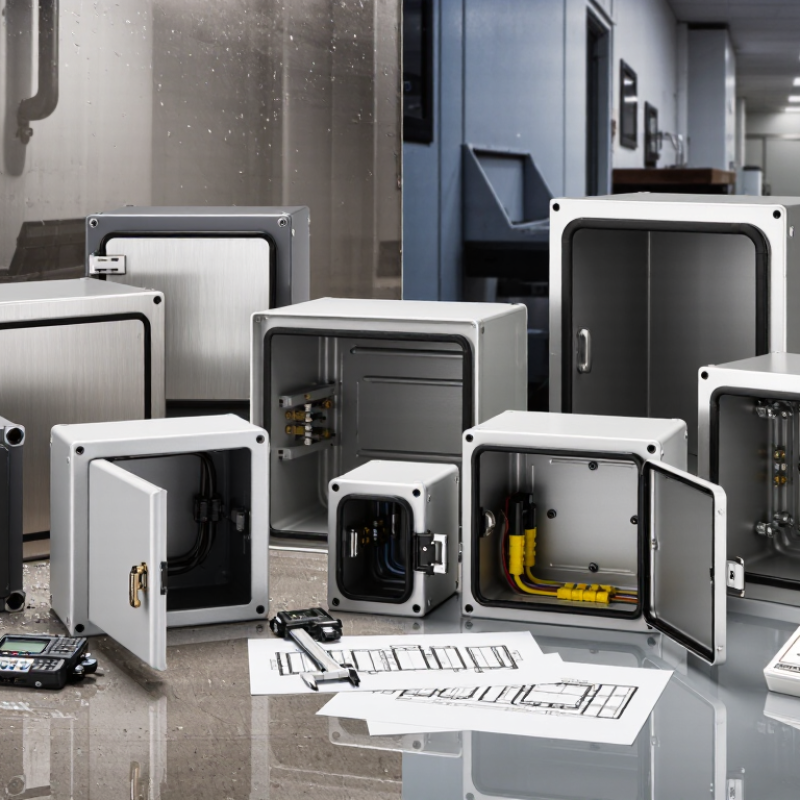
How to Choose the Right Metal Enclosure Box?

Define the Purpose and Operating Conditions of the Metal Enclosure

Before choosing a metal enclosure, define what it must protect and where it will operate. A control cabinet in a dry indoor room faces different risks from one near washdown areas, salt air, or abrasive dust. Record voltage, heat output, cable entry points, maintenance access, and expected impact. Do not guess the internal temperature. A small temperature rise can shorten component life.

Use recognized ratings to match real conditions. IEC 60529 defines IP65 as protection against dust and water jets, while IP66 adds stronger water-jet protection. These ratings do not automatically confirm chemical resistance, corrosion performance, or outdoor durability. The NACE IMPACT study estimated global corrosion costs at US$2.5 trillion annually, equal to about 3.4% of global GDP. That figure makes material selection more than a cosmetic decision.

Consider painted steel, stainless steel, aluminum, or coated finishes according to exposure. In coastal locations, salt deposits can collect around seams and cable glands. In dusty factories, door seals may require frequent inspection. Ventilation can reduce heat, but it may also admit contaminants. That trade-off is easy to underestimate. Experienced installers often check condensation, sunlight, vibration, and cleaning chemicals before finalizing dimensions. I would also leave practical space for wiring changes, although excessive empty space raises cost and footprint. A well-defined operating profile gives the enclosure a defensible purpose.

Choose the Right Material, Thickness, and Protective Finish

How to Choose the Right Metal Enclosure Box?

Choosing a metal enclosure starts with its environment. Steel offers strength and cost efficiency for indoor control panels. Aluminum is lighter and resists corrosion in humid areas. Stainless steel suits harsh, wet, or chemically exposed locations. The best material depends on more than appearance. Consider weight, vibration, heat, and cleaning requirements before deciding.

Thickness should match the enclosure’s size, mounting method, and internal load. Thin sheet metal may flex when heavy components are installed. Excessive thickness adds weight and complicates drilling. Check door alignment, hinge strength, and cable entry points carefully. A practical sample test can reveal problems that drawings often miss. I once underestimated cable weight, and the door began to sag after installation.

Tips: Inspect welded corners and folded edges for sharp surfaces. Choose a protective finish suited to the environment, not simply the lowest price. Powder coating works well for many indoor applications. Galvanized or specialized finishes can improve outdoor resistance. Confirm coating coverage around holes, seams, and mounting areas. Test color and adhesion on a sample panel first. Small flaws become obvious later. Also consider heat buildup, because a durable finish cannot solve poor ventilation. Protective accessories, sealed glands, and drainage paths may be necessary. Recheck the design after installation; real conditions often differ from the workshop.

Evaluate Size, Layout, Mounting, and Cable Entry Requirements

How to Choose the Right Metal Enclosure Box?

Choosing a metal enclosure starts with the equipment inside, not the empty cabinet. Measure every component, terminal, fuse, and connector. Then reserve at least 20% spare space for heat dissipation and future changes. The 2024 MarketsandMarkets Electrical Enclosures Market report identifies power distribution and control systems as major demand areas. These applications often require practical expansion space. A crowded layout looks efficient. It rarely remains efficient.

Mounting conditions also deserve careful attention. Wall mounting, panel mounting, and floor mounting create different loads and access limitations. Check the enclosure’s weight, door swing, fixing points, and service clearance. NFPA 70, 2023 Edition, requires equipment to remain accessible for operation and maintenance. A box mounted beside a pipe may meet the drawing requirement but fail during maintenance. I have seen this mistake more than once.

Cable entry is often underestimated. Count incoming and outgoing cables separately. Confirm gland sizes, bend radius, shield termination, and unused-entry sealing. IEC 60529 defines IP protection levels, but the rating depends on the complete assembly, including doors, glands, and seals. Select the required IP level from the actual environment, not habit. Dusty workshops need different protection from clean indoor rooms. Leave room for fingers and tools. Small details matter.

A final review should test the physical layout, heat path, and installation sequence. Ask someone unfamiliar with the design to inspect it. They may notice what the designer misses.

Check Environmental Protection, Safety, and Compliance Standards

Choosing a metal enclosure box starts with its environmental protection rating, not its appearance. IEC 60529 defines IP codes for resistance to dust and water. An IP65 enclosure, for example, blocks dust and low-pressure water jets. It does not guarantee protection against immersion, chemicals, or condensation. Check the real installation site: outdoor cabinets face rain, salt air, ultraviolet exposure, and temperature swings. A rating can fail after a poorly sealed cable gland is added.

Safety requires more than thick steel. NFPA’s analysis of U.S. home structure fires from 2016–2020 found electrical distribution and lighting equipment involved in 24% of fires. Proper grounding, bonding, ventilation, and clearance can reduce avoidable risks. For low-voltage assemblies, IEC 61439 addresses design verification and temperature-rise performance. NEMA 250 also provides enclosure classifications for specific environmental conditions, but its categories are not identical to IP ratings. This difference is often overlooked. Sometimes, wrongly.

Compliance evidence should match the project’s location and voltage system. Request test reports, material specifications, corrosion data, and documented inspection procedures. Confirm whether the enclosure supports the required short-circuit rating, flammability performance, and ingress protection after modification. A factory rating may no longer apply after drilling new holes. That detail matters. Reviewers should also check hinges, locks, gasket compression, and sharp metal edges during a physical sample inspection. Standards guide the decision, but field conditions expose weaknesses that paperwork can miss.

How to Choose the Right Metal Enclosure Box?

Check environmental protection, safety, and compliance standards before selecting an enclosure.

How to read the chart: The first number in an IP code indicates protection against solid objects and dust, while the second number indicates protection against water. Higher numbers represent a higher standardized protection level under IEC 60529 testing conditions.

Selection guidance: Use IP54 for limited dust and splash exposure, IP65 for dust-tight protection and water jets, IP66 for powerful water jets, and IP67 or IP68 where temporary or continuous immersion may occur. Confirm the exact immersion conditions for IP68 with the enclosure supplier.

Compliance check: In addition to IEC 60529, review mechanical impact resistance under IEC 62262, electrical safety requirements, grounding and bonding provisions, material corrosion resistance, and any applicable local installation standards.

Compare Manufacturing Options, Costs, and Long-Term Maintenance

Choosing a metal enclosure box starts with its working environment, not its appearance. Record heat, moisture, vibration, cable loads, and cleaning chemicals. A stamped steel box suits high volumes because tooling lowers unit cost. However, the initial die investment can be difficult to justify for small batches. Laser-cut and bent panels offer faster revisions and lower setup costs. They may leave visible bend marks and require more finishing. For prototypes, that trade-off is often practical.

Welded construction adds strength around doors, hinges, and mounting points. It also adds labor, distortion risk, and inspection time. Aluminum reduces weight and resists many outdoor conditions, while stainless steel usually costs more to buy and fabricate. Powder coating can protect surfaces, but damaged edges still need prompt touch-up. Ask suppliers for a cost breakdown, including tooling, deburring, coating, packaging, and rejected parts. The lowest quote may exclude useful details.

Long-term maintenance begins with access. A removable panel, captive fasteners, and replaceable seals can shorten service visits. Check gasket compression after repeated opening; a seal that looks intact may already leak. Drainage, ventilation, and grounding points deserve physical inspection, not assumptions. In dusty rooms, filters and cooling fans can become recurring expenses. Keep spare hinges and fasteners on site. Small parts disappear first. I have seen teams optimize purchase price, then spend more on awkward repairs. That mistake is easy to repeat. Before approving production, test a sample through assembly, cleaning, and vibration cycles. Record what actually fails, even if the result makes the original design look less impressive.

How to Choose the Right Metal Enclosure Box? — Compare Manufacturing Options, Costs, and Long-Term Maintenance

Evaluation Dimension Laser-Cut and Bent Sheet Metal Progressive Die Stamping Metal Spinning Die Casting Investment Casting Machined from Solid Stock
Typical Materials Carbon steel, stainless steel, aluminum, galvanized steel Steel, stainless steel, aluminum, copper alloys Aluminum, stainless steel, copper, mild steel Aluminum, zinc, magnesium alloys Stainless steel, carbon steel, aluminum, nickel alloys Aluminum, stainless steel, steel, brass, engineering alloys
Best Production Volume 1–5,000 units per year 10,000–1,000,000+ units per year 100–20,000 units per year 10,000–1,000,000+ units per year 100–50,000 units per year 1–500 units per year
Tooling Investment Low: approximately $100–$5,000 for simple fixtures High: approximately $10,000–$250,000+ for production dies Moderate: approximately $2,000–$30,000 High: approximately $20,000–$150,000+ for molds and tooling Moderate: approximately $5,000–$50,000 depending on pattern complexity Very low: usually no dedicated production tooling
Estimated Unit Cost at Low Volume $20–$150 $50–$300, including tooling amortization $30–$180 $40–$250, including tooling amortization $50–$300 $100–$600+
Estimated Unit Cost at High Volume $8–$60 $1–$15 $5–$35 $2–$20 $8–$50 $50–$300+
Dimensional Accuracy Typically ±0.10–0.50 mm, depending on thickness and bending Typically ±0.05–0.20 mm after process control Typically ±0.20–0.80 mm Typically ±0.10–0.50 mm, with machining for critical features Typically ±0.10–0.50 mm, depending on size and geometry Typically ±0.01–0.10 mm, depending on equipment and design
Suitable Wall Thickness Approximately 0.6–6.0 mm Approximately 0.3–3.0 mm Approximately 0.5–6.0 mm Approximately 0.8–8.0 mm, depending on alloy and casting size Approximately 1.0–10.0 mm Limited mainly by stock size and machining access
Shape Flexibility High for folded, flat-panel, and assembled enclosures Moderate; best for repeatable 2D profiles and formed parts Best for round, cylindrical, conical, and axisymmetric housings High for complex 3D shapes, ribs, bosses, and integrated features Very high for complex shapes and curved surfaces Very high, but internal cavities may require multiple operations
Surface Finish Options Powder coating, wet paint, plating, brushing, anodizing for aluminum Plating, painting, powder coating, brushing, passivation Polishing, brushing, painting, plating, anodizing Powder coating, painting, plating, anodizing, chromate conversion Polishing, passivation, electropolishing, painting, plating Anodizing, powder coating, plating, passivation, polishing
Corrosion Resistance Good with stainless steel or a suitable protective coating Good with stainless steel, plating, or corrosion-resistant coating Good with aluminum or stainless steel; coating may be required for carbon steel Moderate to good; coating is often recommended for outdoor exposure Good to excellent when corrosion-resistant alloys are selected Good to excellent, depending on material and final treatment
Typical Maintenance Needs Inspect coating, hinges, fasteners, seals, and grounding points annually Inspect coating and high-use joints; replacement parts may require matched tooling Inspect seams, fasteners, coating, and seals annually Check coating for chips, inspect porosity-related corrosion, and replace seals as needed Inspect surface finish, fasteners, seals, and weld or joint areas Inspect machined interfaces, fasteners, seals, and surface treatment
Repairability in the Field High; panels can often be replaced or reworked locally Moderate to low; replacement parts may depend on original tooling Moderate; dents and round-form damage may require specialized repair Moderate; damaged castings are usually replaced rather than repaired Moderate; repair depends on wall thickness and casting complexity High for simple features; replacement parts can be reproduced from drawings
Lead Time for Initial Production Approximately 2–6 weeks Approximately 8–20 weeks, including die design and trials Approximately 4–10 weeks Approximately 10–24 weeks, including mold development Approximately 8–18 weeks Approximately 1–6 weeks
Waste and Material Efficiency Good; nesting and remnant management can reduce scrap Very good after process stabilization, although coil scrap is generated Very good because blanks are formed with relatively little waste Good; runners and gates can often be recycled within the process Moderate; sprues, gates, and shell material create process waste Low to moderate; substantial chips may be produced from billet or plate
Recommended Use Case Prototypes, custom panels, control boxes, electrical cabinets, and medium-volume projects Small, repeatable enclosures with stable designs and very high annual demand Round sensor housings, lighting bodies, pressure-related covers, and cylindrical boxes Complex lightweight housings with integrated ribs, bosses, and mounting features Complex corrosion-resistant housings requiring near-net-shape production Low-volume precision housings, development units, and designs requiring tight tolerances
Cost and performance note: The figures are practical industry planning ranges in USD and vary with enclosure size, material grade, wall thickness, tolerances, finish, order quantity, geographic location, and inspection requirements. Final quotations should be based on a fully dimensioned drawing and the required environmental rating.

FAQS

How do I choose the right metal for an enclosure?

Choose steel for strong, cost-effective indoor panels. Aluminum is lighter and handles humid conditions well. Stainless steel suits wet or chemically exposed areas. Consider vibration, heat, cleaning, and weight. Appearance is not enough.

How thick should the metal enclosure be?

Match thickness to the box size, mounting method, and internal load. Thin metal may flex under heavy components. Excessive thickness adds weight and complicates drilling. Test a physical sample. Drawings can miss weak points.

What protective finish works best?

Select the finish according to the environment. Powder coating suits many indoor applications. Outdoor locations may need galvanized or specialized protection. Inspect coating around holes, seams, and mounting points. Tiny flaws become visible later.

Does an IP rating guarantee complete protection?

No. An IP65 enclosure blocks dust and low-pressure water jets. It does not guarantee immersion, chemical resistance, or condensation protection. A badly sealed cable gland can defeat the rating. Check the real site.

What should I inspect for enclosure safety?

Check grounding, bonding, ventilation, clearance, hinges, locks, and gasket compression. Inspect sharp edges during a physical sample review. Thick steel alone does not create safety. Heat can build up quickly.

How do I select a manufacturing method?

Stamped steel works well for high volumes. Laser-cut and bent panels suit prototypes and design changes. Welding improves strength around hinges and mounting points. It may also increase distortion, labor, and inspection time. The cheapest method is not always practical.

What costs should I include beyond the purchase price?

Include tooling, deburring, coating, packaging, rejected parts, and future repairs. A low quote may hide important work. Filters, fans, spare hinges, and replacement seals create recurring costs. Small parts disappear first.

How can I reduce future maintenance problems?

Use removable panels, captive fasteners, replaceable seals, drainage, and accessible grounding points. Check gasket compression after repeated opening. Dust can block filters and cooling fans. Test assembly, cleaning, and vibration cycles before production. I underestimated cable weight once. The door sagged.

Conclusion

Choosing the right Metal Enclosure Box begins with clearly defining its purpose and operating environment. Consider whether it will be used indoors or outdoors, exposed to moisture, dust, chemicals, heat, vibration, or physical impact. Then select a suitable material, wall thickness, and protective finish to provide the required strength, corrosion resistance, and service life. The enclosure should also offer enough internal space for equipment, wiring, ventilation, and future expansion.

Before making a final decision, evaluate dimensions, component layout, mounting methods, and cable entry points to ensure safe and efficient installation. Check the enclosure’s environmental protection rating, electrical safety features, grounding options, and applicable compliance requirements. Finally, compare manufacturing methods, customization capabilities, initial costs, delivery time, and long-term maintenance needs. A well-chosen Metal Enclosure Box should balance protection, usability, durability, and total value while supporting reliable performance throughout its service life.


Charlotte

Charlotte

Charlotte is a seasoned marketing professional with a deep understanding of the company's portfolio and a passion for elevating its presence in the market. With a keen eye for detail and a commitment to excellence, she ensures that our professional blog is regularly updated with insightful articles......