Choosing the best Tool Cabinet in 2026 requires more than comparing drawer counts or polished finishes. A serious cabinet must protect tools, support daily work, and fit the user’s available space. It should roll smoothly across concrete floors, hold heavy equipment without twisting, and keep small parts visible. Noise matters, too.
Professional tool reviewer Tony Carrick describes the practical standard this way: “The best tool storage keeps your tools organized, protected, and ready to use.” That principle remains valuable in 2026, when cabinets increasingly combine steel construction with modular layouts, soft-close drawers, digital locks, and integrated power outlets.
Still, technology is not everything. A cabinet with app controls may look impressive, yet fail in a crowded workshop. A thinner model may cost less, but its drawers can flex under large sockets and power tools. Measure carefully. Check the load rating. Test the caster brakes.
The right choice depends on real working habits. An automotive technician may need deep drawers and strong side storage. A home user may prefer a compact cabinet with quieter movement. A mobile repair team needs secure locking and reliable wheels.
There is no perfect cabinet. That is worth admitting. Even premium models can have weak drawer liners, awkward handles, or unclear assembly instructions. This guide compares construction, capacity, mobility, security, ergonomics, and long-term value. It also considers a detail many buyers overlook: how easily the cabinet can adapt when the tool collection grows.
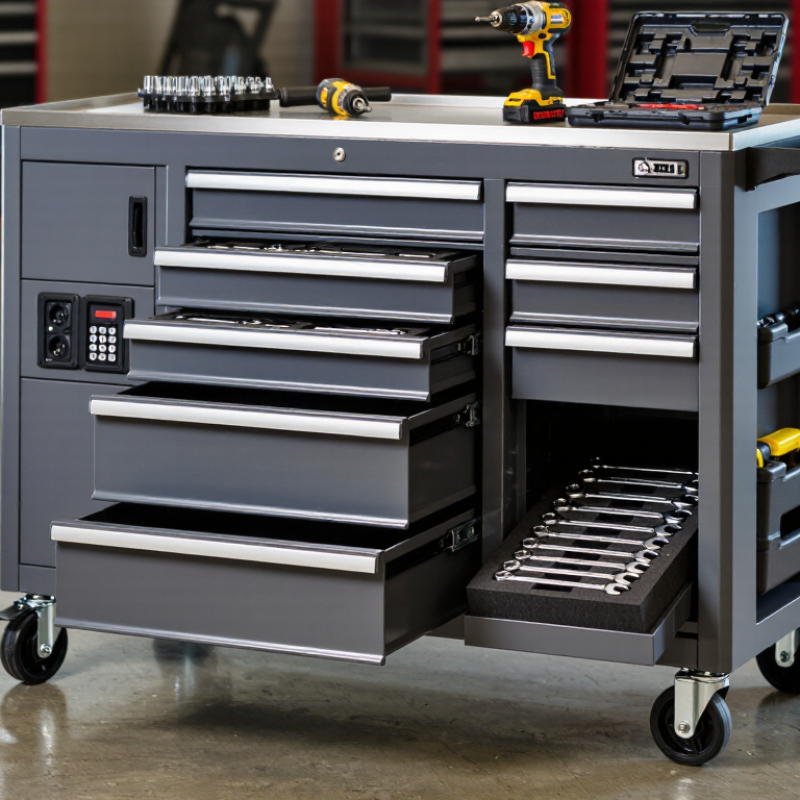
The best tool cabinet in 2026 is not defined by size or appearance. It is defined by control, safety, and daily usability. A reliable cabinet should support its stated load without bending, sticking, or becoming unstable. Thick steel, reinforced drawer slides, and balanced weight distribution matter more than polished paint.
Good storage also matches real working habits. Full-extension drawers should open smoothly, even when filled with sockets and hand tools. A secure locking system protects equipment from casual access. Large swivel casters help the cabinet move across concrete floors, while strong brakes keep it steady during repairs. Rounded edges reduce painful bumps in crowded workshops. Small details count.
I once used a cabinet with impressive capacity but weak drawer alignment. It looked professional, yet heavy drawers dragged after several months. That experience changed my buying criteria. The best cabinet should be easy to inspect, clean, repair, and organize. Clear labels and removable dividers prevent wasted motion. Ventilation may also help in damp work areas.
Perfection is unlikely.
Buyers should compare specifications with real use, not advertising language. Check the actual drawer capacity, wheel construction, warranty terms, and replacement-part access. A cabinet that fits your tools, floor, and working posture will usually outperform a larger model that creates clutter. Reliability appears during ordinary work, not showroom inspection.
A modern tool cabinet should fit your work, not merely look impressive. I compare capacity, drawer layout, steel thickness, and movement before considering appearance. A cabinet with deep drawers may hold power tools, while shallow drawers keep sockets visible. Measure your workspace carefully. Twenty millimeters can decide whether the doors open fully.
Drawer slides deserve close attention. Full-extension ball-bearing slides let you reach the rear without scraping your knuckles. Test them with real tools, not empty drawers. The advertised load rating matters, but weight distribution matters too. Heavy equipment belongs in lower drawers. This reduces tipping and makes daily use smoother. Anti-tip mechanisms add protection, especially when several drawers open accidentally.
Mobility is another practical test. Locking casters should roll across concrete without wobbling. Two fixed wheels and two swivel wheels often provide predictable control. Check the brake with one hand. A weak brake becomes annoying quickly. Look for a corrosion-resistant finish, reinforced corners, and a lock that does not feel fragile. A replaceable liner can reduce noise and protect small instruments. I still think manufacturers should publish clearer long-term slide testing. A cabinet may feel excellent in a showroom, yet loosen after months of dust, vibration, and uneven loading. Reliable specifications, accessible service information, and a realistic warranty deserve the same attention as drawer count.
| Comparison Dimension | Compact Mobile Cabinet | Standard Professional Cabinet | Heavy-Duty Workshop Cabinet | Modular Cabinet System | Best Feature for 2026 |
|---|---|---|---|---|---|
| Typical Overall Width | 24–36 in (610–914 mm) | 40–56 in (1,016–1,422 mm) | 60–84 in (1,524–2,134 mm) | 48–96+ in (1,219–2,438+ mm) | Choose according to available wall and floor space |
| Typical Overall Height | 32–40 in (813–1,016 mm) | 36–42 in (914–1,067 mm) | 36–48 in (914–1,219 mm) | 36–84 in (914–2,134 mm) | Adjustable height is ideal for changing work areas |
| Typical Depth | 18–24 in (457–610 mm) | 22–27 in (559–686 mm) | 24–30 in (610–762 mm) | 22–30 in (559–762 mm) | 24–27 in balances storage and walk-around clearance |
| Recommended User | Home workshop, hobbyist, field technician | Automotive technician, maintenance professional | Fabrication shop, industrial maintenance team | Shared workshop, expanding tool collection | Match the cabinet to workload and future expansion |
| Typical Number of Drawers | 4–7 drawers | 7–14 drawers | 10–18 drawers | 6–20 drawers per module | Full-extension drawers improve access to stored tools |
| Typical Drawer Load Rating | 50–100 lb (23–45 kg) per drawer | 100–200 lb (45–91 kg) per drawer | 200–300 lb (91–136 kg) per drawer | 100–250 lb (45–113 kg) per drawer | Look for clearly stated load ratings |
| Typical Total Storage Capacity | 8,000–18,000 cu in | 18,000–35,000 cu in | 30,000–60,000+ cu in | 20,000–80,000+ cu in | Modular capacity is best for long-term growth |
| Common Steel Construction | 18–20 gauge steel | 18–20 gauge steel | 16–18 gauge steel | 18–20 gauge steel with reinforced frames | Thicker steel generally improves rigidity and durability |
| Drawer Extension | Partial or full extension | Full extension is common | Full extension with heavy-duty slides | Full extension on most working drawers | Full extension provides better visibility and access |
| Mobility | Four casters, usually two locking | Four to six casters, usually two or more locking | Six or more reinforced casters | Fixed, mobile, or mixed configuration | Locking casters are essential on uneven or busy floors |
| Recommended Caster Diameter | 3–4 in (76–102 mm) | 4–5 in (102–127 mm) | 5–6 in (127–152 mm) | 4–6 in (102–152 mm), depending on module weight | Larger casters roll more easily over joints and thresholds |
| Locking System | Basic central key lock | Central key lock or tubular lock | Reinforced central lock with drawer interlock | Individual or linked locks by module | Drawer interlock reduces tip-over risk |
| Tip-Over Protection | Limited; one drawer at a time on some models | Commonly integrated | Strongly recommended and usually integrated | Must be checked for each connected module | Prioritize an interlocking drawer mechanism |
| Worktop Options | Steel or thin rubber mat | Steel, rubber mat, or wood worktop | Thick steel, hardwood, or impact-resistant composite | Replaceable wood, steel, or composite sections | Replaceable surfaces extend service life |
| Electrical and Charging Features | Usually limited or unavailable | Power strip or cable pass-through may be available | Integrated power, lighting, and cable management are common options | Best suited to expandable power and charging modules | Built-in cable management reduces clutter and trip hazards |
| Security and Data Features | Mechanical lock | Mechanical lock; electronic options may be available | Reinforced lock with optional access control | Centralized or module-specific access control | Electronic access is useful where tool accountability matters |
| Ease of Reconfiguration | Low | Medium | Medium | High | Modular layouts adapt best to changing workflows |
| Space Efficiency | High in small work areas | High for general-purpose workshops | Requires substantial floor space | High when configured vertically | Use vertical storage when floor space is limited |
| Best Overall Use Case | Portable everyday tool storage | Balanced professional use | Maximum capacity and heavy-duty service | Flexible storage for growing operations | A professional cabinet with full-extension drawers, locking casters, tip-over protection, and modular expansion |
Specifications are typical market ranges for modern steel tool cabinets. Actual capacity, load rating, materials, and safety features vary by configuration and should be verified against the product’s technical documentation before purchase.
The best tool cabinet depends on your workspace, equipment, and daily habits. A rolling drawer cabinet suits garages and workshops that need flexible storage. Its shallow drawers keep sockets, pliers, and measuring tools visible. Larger bottom drawers hold drills, clamps, or protective equipment. Choose full-extension slides and a stated load rating. A lock is useful, but stable construction matters more.
Wall-mounted cabinets save valuable floor space in compact work areas. They work well for hand tools, fasteners, and small electrical supplies. Keep frequently used items near eye level. However, overloaded wall units can strain weak surfaces. Check the mounting structure carefully. Do not trust appearance alone.
Modular cabinets support growing tool collections. Add-on sections can separate woodworking, mechanical, and maintenance equipment. This arrangement reduces searching and prevents delicate tools from rubbing together. Mobile service cabinets are better for repair tasks across large facilities. Strong casters and a secure push handle are essential. I once chose storage by drawer count and regretted ignoring drawer depth. Some drawers looked generous but wasted space around bulky tools. Measure twice. Think about tomorrow’s tools, too. A practical cabinet should open smoothly, resist tipping, and fit the worker’s reach. Fancy features can help, but reliable access usually matters more.
What Is the Best Tool Cabinet in 2026?
Choosing the right tool cabinet starts with your workspace, not a product image. Measure wall clearance, walkway width, and floor strength. A cabinet that fits tightly may still block drawers or emergency access. For a repair bench, shallow drawers keep daily tools visible. Deeper drawers suit bulky equipment, but they become heavy quickly. Check the cabinet’s stated load rating, drawer extension, lock quality, and wheel brakes. Avoid judging capacity by drawer count alone. A ten-drawer cabinet can waste space if every drawer is narrow.
Safety should guide the decision. The U.S. Bureau of Labor Statistics reported about 2.6 million nonfatal workplace injuries and illnesses in private industry during 2023. Poor storage is not responsible for every case, but clutter and awkward lifting can increase exposure. OSHA material-handling guidance emphasizes stable storage and clear pathways. Choose a low center of gravity for a crowded workshop. Anti-tip protection matters when several drawers open together. I have found that bright labels save more time than extra compartments. Still, labels fade, and my first layout often needs revision.
Tips: Measure twice. Leave 10 centimeters behind the cabinet for cleaning and cables. Store heavy tools below waist height. Test one fully loaded drawer before buying. Compare actual usable depth, not advertised width. If the floor is uneven, adjustable feet may outperform casters. Monthly inspections catch loose wheels, damaged slides, and overloaded drawers early. The best cabinet is the one your team can reach, control, and maintain every day.
Compare three practical cabinet sizes by usable storage volume. The volume is calculated from the listed width, depth, and height, so it can be matched to your available workspace.
A compact cabinet suits limited spaces and light tool collections. A standard cabinet offers a balanced combination of capacity and footprint, while a large cabinet is better for professional workshops with more tools and sufficient floor space. Before choosing, also check drawer load ratings, locking requirements, mobility, and aisle clearance.
The best tool cabinet is not the largest one. It is the safest cabinet that fits the workflow, load, and workspace.
Maintenance determines long-term value. Inspect casters, drawer slides, handles, and fasteners every month. Wipe metal surfaces dry, especially after coolant or humid work. A small amount of approved lubricant can reduce friction, but excess oil attracts abrasive dust.
I have seen cabinets fail from poor loading, not weak steel. I have also bought more drawers than the workspace needed. That was wasteful. ISO 55000’s asset-management approach supports evaluating an asset through its whole life, including operation, maintenance, and replacement. Record cabinet damage, drawer usage, and repair time. Replace worn wheels before movement becomes unsafe. A durable finish helps, but disciplined storage creates more value than appearance.
Measure your workspace carefully.
Shallow drawers keep sockets, pliers, and measuring tools visible.
They let you reach the back of each drawer.
Store heavy equipment in lower drawers.
An anti-tip mechanism helps prevent several drawers opening together.
Locking casters should roll smoothly across concrete.
It saves floor space in compact work areas.
Modular sections can separate woodworking, mechanical, and maintenance tools.
Look for corrosion-resistant surfaces and reinforced corners.
Not completely.
Choosing the best Tool Cabinet in 2026 means finding a balance between durability, organization, security, mobility, and smart workspace design. A modern cabinet should provide strong construction, smooth and reliable drawers, practical storage capacity, safe locking features, and a layout that keeps frequently used tools easy to access. Options may include rolling cabinets for flexible work areas, stationary cabinets for maximum stability, modular systems for expansion, and compact models for limited spaces. The ideal choice depends on the size of your workspace, the number and type of tools you own, your weight requirements, and whether you need portability or permanent storage.
Long-term value also depends on safety and maintenance. A well-designed Tool Cabinet should remain stable when drawers are opened, distribute weight evenly, and include features that reduce accidental movement. Regular cleaning, lubrication, inspections, and proper drawer loading can extend its service life. By comparing construction quality, storage efficiency, safety features, and future adaptability, users can select a cabinet that improves productivity and keeps their workspace organized for years.